On the documented Genie Excelerator family, three repeating status-light blinks mean the garage door opener is overheated or over-cycled. Genie specifically says not to unplug or disconnect power. Wait about 10 minutes so the internal clock can restore additional cycles; the manufacturer says cycles are restored at a rate of five cycles per 10 minutes of rest. If three blinks return during ordinary household use, stop treating repeated rest periods as the fix and investigate abnormal cycling, door load, or a model-specific service issue.
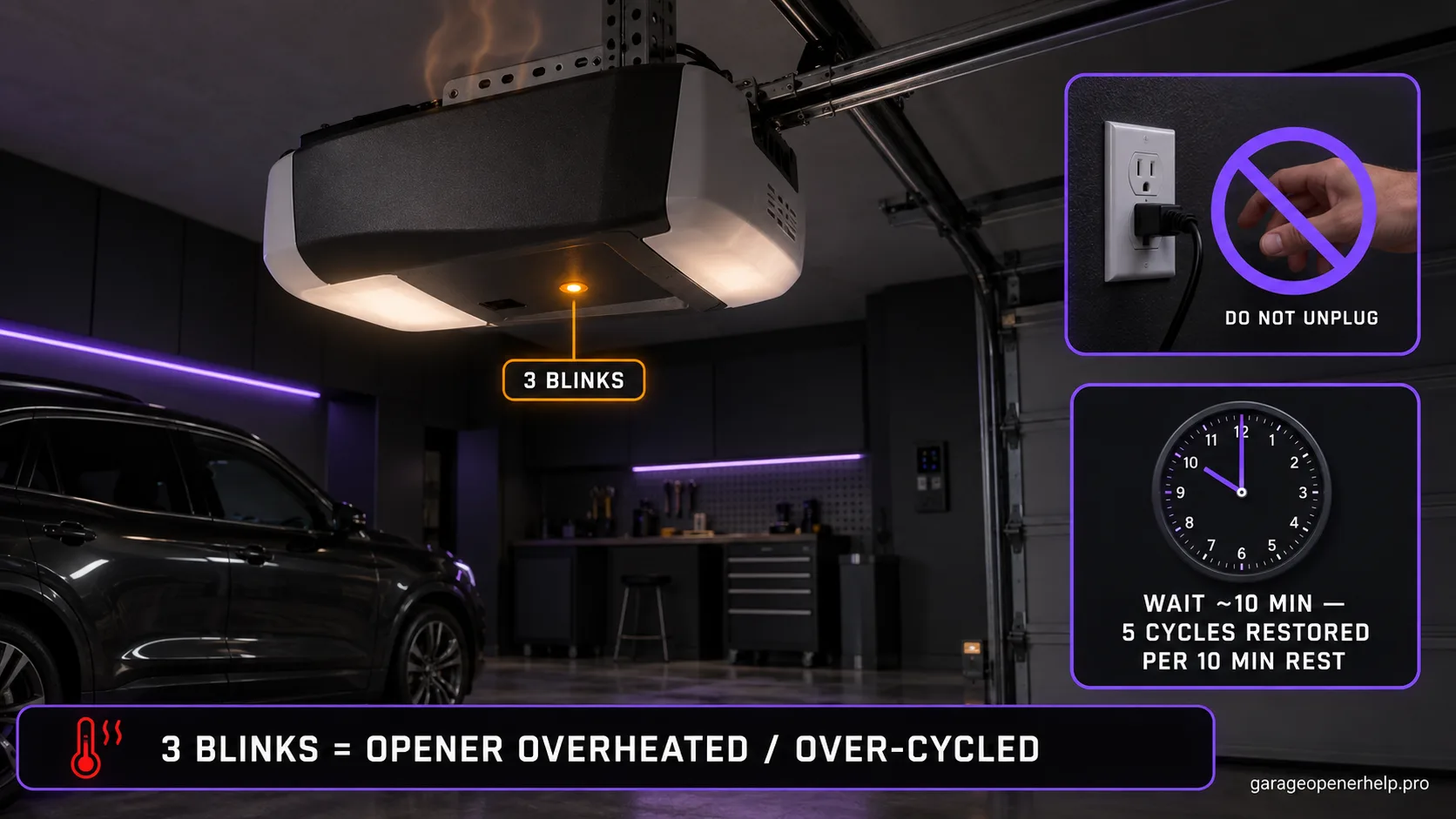
Diagnostic snapshot
- Answer
- Three repeating Genie Excelerator status-light blinks mean the opener is overheated or over-cycled.
- Check first
- Do not unplug it; Genie says to leave power connected and wait about 10 minutes for cycle allowance to recover.
- Strong clue
- A code that follows many rapid cycles and clears after undisturbed rest fits duty-cycle protection much better than a permanent board failure.
- Model / generation note
- Do not confuse this with three green blinks on the 1022/2022-family chart, where Genie says the limits are set backwards.
This exact manufacturer signal can feed the following diagnostic family. Keep the original code or LED pattern when troubleshooting.
What you are likely to notice
- The Excelerator status light blinks three times, pauses, then repeats
- The opener was operated many times in a short period
- The motor/powerhead may be warm after repeated cycles
- Normal operation may return after an undisturbed rest period
Check these in order
1. Confirm the three-blink pattern and recent usage
This is the Excelerator thermal/cycle-limit signal, not the three-green-blink reversed-limits code on Genie's 1022/2022-family chart. Count the powerhead blinks carefully and note whether the opener has been run repeatedly for testing, moving items, programming, or troubleshooting.
2. Follow Genie's instruction: do not unplug it
For Excelerator three blinks, Genie explicitly says not to unplug or disconnect power. Leave the opener alone for about 10 minutes so the internal clock can restore cycle allowance. This differs from the reset procedure used for one- and two-blink Excelerator board interrupts.
3. Avoid using repeated test cycles as troubleshooting
Genie states that five cycles are restored per 10 minutes of rest. Repeatedly running the opener as soon as a cycle becomes available can keep recreating the same condition and obscure the original symptom. After the rest period, use only the minimum supervised cycle needed to confirm behavior.
4. If it overheats during normal use, look beyond the cycle counter
A residential opener should not need constant recovery during ordinary use. If three blinks return without unusually frequent operation, record door balance/binding observations, ambient conditions, exact model, and how many cycles occurred before the code. That pattern deserves manufacturer or qualified service review rather than repeatedly waiting and continuing.
Three blinks use the opposite power advice from one and two blinks
This is an easy place to make a bad troubleshooting habit. Genie's one- and two-blink Excelerator faults begin with a short power reset, but the three-blink overheated/over-cycled condition explicitly says not to unplug or disconnect the opener. The internal clock needs power while cycle allowance recovers.
That difference is exactly why model-family and blink-count accuracy matter. Generic advice to 'power cycle the opener' would contradict the manufacturer for this condition.
The cycle-recovery rate explains why constant testing can keep the code alive
Genie says five cycles are restored for every 10 minutes of rest. If someone repeatedly tests the opener during programming or troubleshooting, the operator can remain in the same over-cycled state even though no permanent failure exists.
After an undisturbed rest, perform only the minimum supervised operation required. If normal use immediately recreates the code, that is a different pattern than a code that followed dozens of intentional cycles.
When heat is a symptom rather than the diagnosis
A powerhead can become warm after repeated work, but smoke, burn odor, extreme heat, or visible damage is not a normal 'wait ten minutes' condition. Stop using the opener if those signs appear. The self-diagnostic chart does not replace basic electrical/fire safety.
Likewise, a heavy or binding garage door can make the opener work harder. If three blinks appear during ordinary use and the door does not move freely in the manual test described by its manual, the door-system load deserves attention rather than extending rest periods indefinitely.
What a useful recurrence record looks like
Write down approximately how many cycles occurred before the three-blink code, how long the opener rested, whether the code cleared without removing power, and whether it returned after one ordinary cycle. Also record garage temperature and any abnormal door resistance.
Those details separate expected duty-cycle protection from a unit that reaches protection unusually quickly. They give Genie support or a technician a much better starting point than simply saying the opener overheats.
Stop DIY troubleshooting when…
- The powerhead is excessively hot, smells burned, smokes, or shows visible damage
- Three blinks return after only normal household cycling
- The garage door is heavy, binding, or mechanically unsafe
- The opener repeatedly stops during travel even after an adequate rest period
Garage door springs, cables and a falling/unbalanced door can store or release dangerous force. Those are door-system problems, not just opener settings.
Common questions
What do three blinks mean on a Genie Excelerator?
Genie says the opener is overheated or over-cycled.
Should I unplug an Excelerator showing three blinks?
No. Genie specifically says not to disconnect power; wait about 10 minutes so the internal clock can restore additional cycles.
How quickly do cycles come back?
Genie's chart says five cycles are restored per 10 minutes of rest.
Manufacturer sources used
These links are the factual baseline for the diagnostic claims above. Model-specific manuals can supersede general guidance.