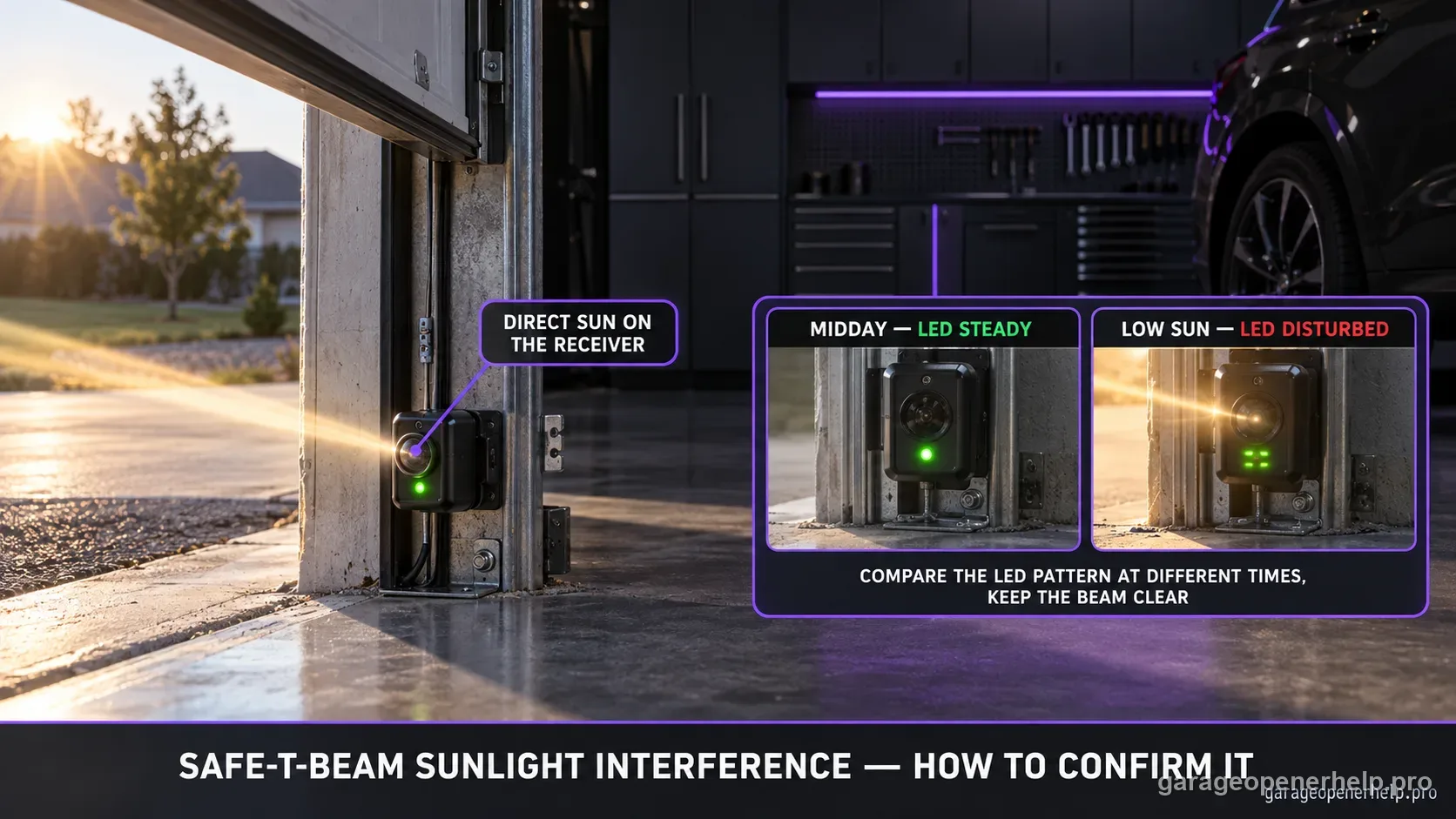
Genie support notes that direct sunlight can interfere with the Safe-T-Beam receiver, the unit with the green LED. If the fault tracks strong sunlight, compare the LED pattern at different times and follow Genie’s positioning guidance while maintaining a clear beam between the sensors.
Read Genie Safe-T-Beam red and green LEDs together
What is each Safe-T-Beam eye reporting at the same time?
Record both LED states before choosing a blink-code branch.
Genie identifies the red LED unit as the source/transmitter and the green LED unit as the receiver. A blink count is not enough by itself: several diagnostic branches change depending on whether the other LED is steady, off or also abnormal.
What you are likely to notice
- The closing fault is worse at a particular time of day
- The green receiver is on the side receiving strong direct sunlight
- The Safe-T-Beam blink state clears when lighting conditions change
Check these in order
1. Look for a time-of-day pattern
Write down whether the problem appears only when sunlight enters the doorway at a certain angle. A repeatable environmental pattern is stronger evidence than simply seeing a bright garage.
2. Clean and align before blaming the sun
Remove cobwebs and dirt and confirm the sensors face each other. Obstruction and misalignment are more common branches and can coexist with bright light.
3. Identify the green receiver side
Genie identifies the green LED unit as the receiver and specifically notes direct sunlight interference at the receiver. Follow the manufacturer positioning guidance without blocking the beam or defeating the safety system.
4. Check for cross-talk on multiple adjacent doors
Genie also notes that nearby door sensor sets can see the wrong transmitter and that reflective surfaces can contribute. This is particularly relevant in multi-door garages.
Use timing to prove an environmental fault
A sunlight diagnosis is much stronger when the same door works in shade and fails when direct sun hits the receiver at a repeatable time. Record the LED state in both conditions. This prevents an unrelated loose wire from being mislabeled as sunlight interference.
Genie specifically calls out direct sunlight at the green receiver and also discusses cross-talk between multiple adjacent sensor pairs and reflections from shiny surfaces. Those are manufacturer-recognized interference paths, not generic internet guesses.
Do not solve interference by defeating the beam
Any repositioning still has to leave the two sensors with an unobstructed line of sight and a stable installation. The goal is a solid red and solid green state with a working reversal test, not simply hiding the receiver from light at any cost.
In a multi-door garage, verify each receiver is paired across its own opening rather than accidentally seeing a neighboring transmitter. A repeatable cross-talk pattern can look like an intermittent sensor failure.
Prove interference by repeatability, not by the time of day alone
Genie separates interference from ordinary alignment in its Safe-T-Beam diagnostics. A three-red-blink repeating pattern with the green LED ON points to the sensor receiving interference. That pattern is stronger evidence than simply noticing that the problem happens on a sunny afternoon, because sunlight can be blamed for unrelated wiring or alignment faults by coincidence.
Record whether the three-blink state appears only when direct light reaches the receiving area and whether shading the sensor changes the diagnostic state without moving the bracket. Also rule out cross-talk or other infrared sources if multiple door openings or nearby sensors are present. If the LED pattern is two blinks or both lights are off, move back to the corresponding official branch instead of calling it sunlight interference.
- Look for the three-red-blink + green-ON interference pattern.
- Use a repeatable change with light/shading as evidence; do not rely only on clock time.
- A different blink pattern means a different Safe-T-Beam branch.
If interference is suspected, record the three-blink pattern and one controlled observation: for example, the diagnostic state changes when direct light is blocked while the sensor itself is not moved. Also note nearby photo-eye systems or newly added electronics. This gives support a repeatable environmental clue instead of a vague statement that the problem 'usually happens in the afternoon.'
Stop DIY troubleshooting when…
- The sensor cannot be positioned securely
- The interference pattern persists without a safe manufacturer-supported placement
- Wiring is damaged
- You would need to bypass or shield the sensor in a way that defeats Safe-T-Beam operation
Garage door springs, cables and a falling/unbalanced door can store or release dangerous force. Those are door-system problems, not just opener settings.
Common questions
Can direct sunlight affect Genie Safe-T-Beam?
Yes. Genie support specifically notes direct sunlight interference at the green receiver.
Can two garage doors interfere with each other's sensors?
Genie notes possible cross-talk in multiple-door garages and recommends checking sensor placement so each receiver sees the intended transmitter.
What should normal Genie Safe-T-Beam LEDs look like?
Solid red and solid green indicates normal operation.
Manufacturer sources used
These links are the factual baseline for the diagnostic claims above. Model-specific manuals can supersede general guidance.