A door that only opens halfway or stops partway up is not automatically a travel-limit problem. Chamberlain Group tells owners to verify door balance and binding first; if the opener still stops early with the door disconnected from the trolley, the fault shifts toward the opener/drive system rather than the door itself. If it closes normally but will not open fully, the up-travel limit or up-force setting is the next thing to check after the mechanical branch is clear.
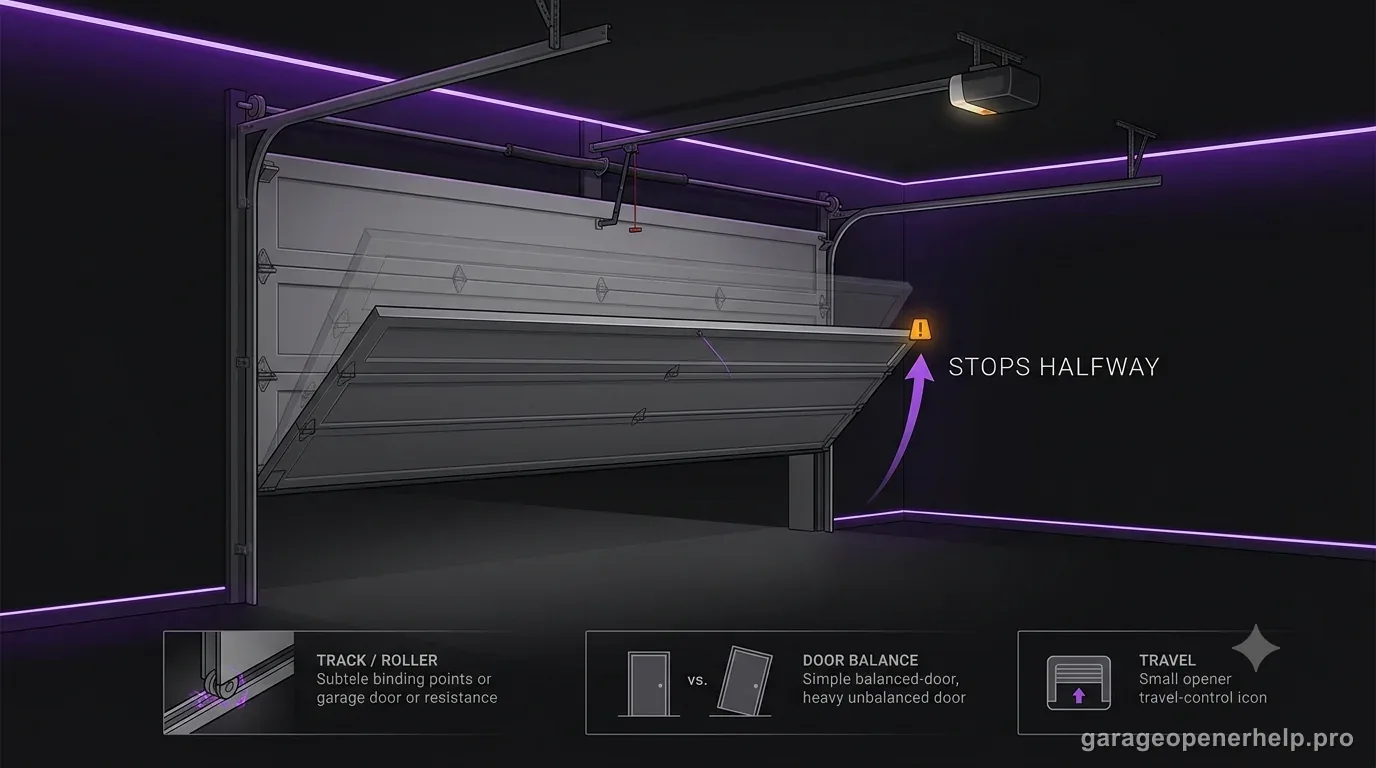
Separate door resistance from opener travel before adjusting settings
Does the door move freely by hand when it is safe to disconnect the opener?
A partial-opening symptom can come from the door system or from opener travel/force behavior. Chamberlain Group guidance checks obstruction and door movement before treating travel settings as the only explanation.
What you are likely to notice
- The door only opens halfway, or stops partway up—often at about the same point each time
- The door will not open all the way to fully raised
- The door may still close normally afterward
- The opener may beep, flash five times on affected units, or report an opening-force diagnostic
Check these in order
1. Separate a repeatable stop from random stopping
Note whether the door stops at nearly the same rail/door position each time. A fixed position can suggest a learned travel boundary or a specific mechanical bind; inconsistent stopping can point toward resistance, drive or sensing problems.
2. Check for mechanical resistance
Inspect the visible track and door path for obvious rubbing, bent hardware or objects. If the closed door can be safely disconnected according to the manual, compare manual travel. A door that becomes noticeably harder to lift at the same point needs door service before opener adjustments.
3. Use the disconnected-trolley test as a separator
Chamberlain’s full-travel guidance uses opener operation without the door connected to distinguish a door problem from an opener problem. If the trolley travels fully without the door, the door/mechanical branch becomes more likely; if the trolley still stops early, investigate the opener drive and model-specific diagnostics.
4. Reset travel only when the hardware branch is clear
If the door and trolley move freely and the opener simply learned an incorrect UP point, follow the exact model’s travel procedure. After any adjustment, perform the manufacturer-required safety reversal test.
Halfway is a symptom description, not a diagnosis
People often search 'stops halfway' even when the actual stopping point is one-third or two-thirds open. The useful part is whether it stops at a repeatable position and whether the same resistance is present when the door is moved manually. That turns a broad symptom into something you can test.
If the door closes normally but opening stops partway, the safety photo eyes are less likely to explain the opening failure by themselves. Opening-force detection, door resistance, a drive issue or an incorrectly learned open point move higher on the list.
The disconnected-opener test can separate two systems
Chamberlain's full-travel troubleshooting recommends running the opener with the door disconnected as a separator. If the trolley travels the full rail without the door, the opener has demonstrated that it can make the trip and the door/mechanical branch becomes more likely. If the trolley still stops early, the problem remains in the opener/drive/position-sensing branch.
Only perform this type of test with the door fully closed and stable, following the opener manual. Do not disconnect an open or unstable door, and do not work around springs or cables.
After repairs, do not skip the safety test
A corrected travel point or force-learning cycle should be followed by the manufacturer's safety reversal test. This is especially important after a symptom that was tempting you to increase force; the system must still reverse as designed.
If a mid-travel stop returns after successful setup, record whether it happens at the exact same location and whether an error code appears. Recurrence at the same rail position can be a valuable clue for model-specific service.
Check whether the stop follows the door or the opener
A useful comparison is whether the physical door becomes difficult at the same height where the automatic opener stops. If it does, the location itself is evidence of a roller, hinge, track, balance or door-geometry problem. If the door remains smooth but the opener/trolley stops at that rail position, the fault follows the opener instead.
Do not turn this into a spring-adjustment DIY task. The value of the manual comparison is diagnostic: it tells you whether the door system or opener deserves service. Do not adjust torsion/extension springs, lift cables or other high-force counterbalance hardware as part of this test.
Why a successful close cycle does not prove the door is healthy
Opening and closing load the door differently. A door can close under gravity and still demand excessive opening force because of poor balance, a sticking roller or resistance near the top of travel. That is why 'it closes fine' is useful information but not proof that the mechanical door is okay.
If the opener reports 4-2 or an obstruction notification during opening, preserve that signal. A repeatable code paired with a repeatable mid-travel stop is much stronger diagnostic evidence than simply reprogramming the UP limit and hoping it disappears.
Stop DIY troubleshooting when…
- The door binds at a specific hinge/roller location
- The opener chain, belt or screw drive behaves abnormally
- The trolley stops early even with the door disconnected
- A spring/cable or balance issue is present
Garage door springs, cables and a falling/unbalanced door can store or release dangerous force. Those are door-system problems, not just opener settings.
Common questions
Why does my garage door open halfway and stop but close normally?
The symptom can come from opening-side resistance, a learned UP travel point, force detection or an opener/drive issue. Check door balance and repeatability before changing settings.
Does a halfway stop mean the travel limit is wrong?
Not always. A door or opener that binds can stop at a similar point. Chamberlain's troubleshooting uses manual door movement and opener travel without the door to help separate those causes.
What if the trolley also stops halfway with the door disconnected?
That shifts the diagnosis toward the opener itself—drive, position sensing, travel programming or another model-specific fault—rather than the garage door hardware.
Manufacturer sources used
These links are the factual baseline for the diagnostic claims above. Model-specific manuals can supersede general guidance.