Chamberlain Group defines 1-1 as a safety-sensor condition caused by blocked or misaligned sensors, disconnected sensors, or a wiring issue. Clear the beam, confirm both sensor LEDs, then inspect the low-voltage connections before replacing parts.
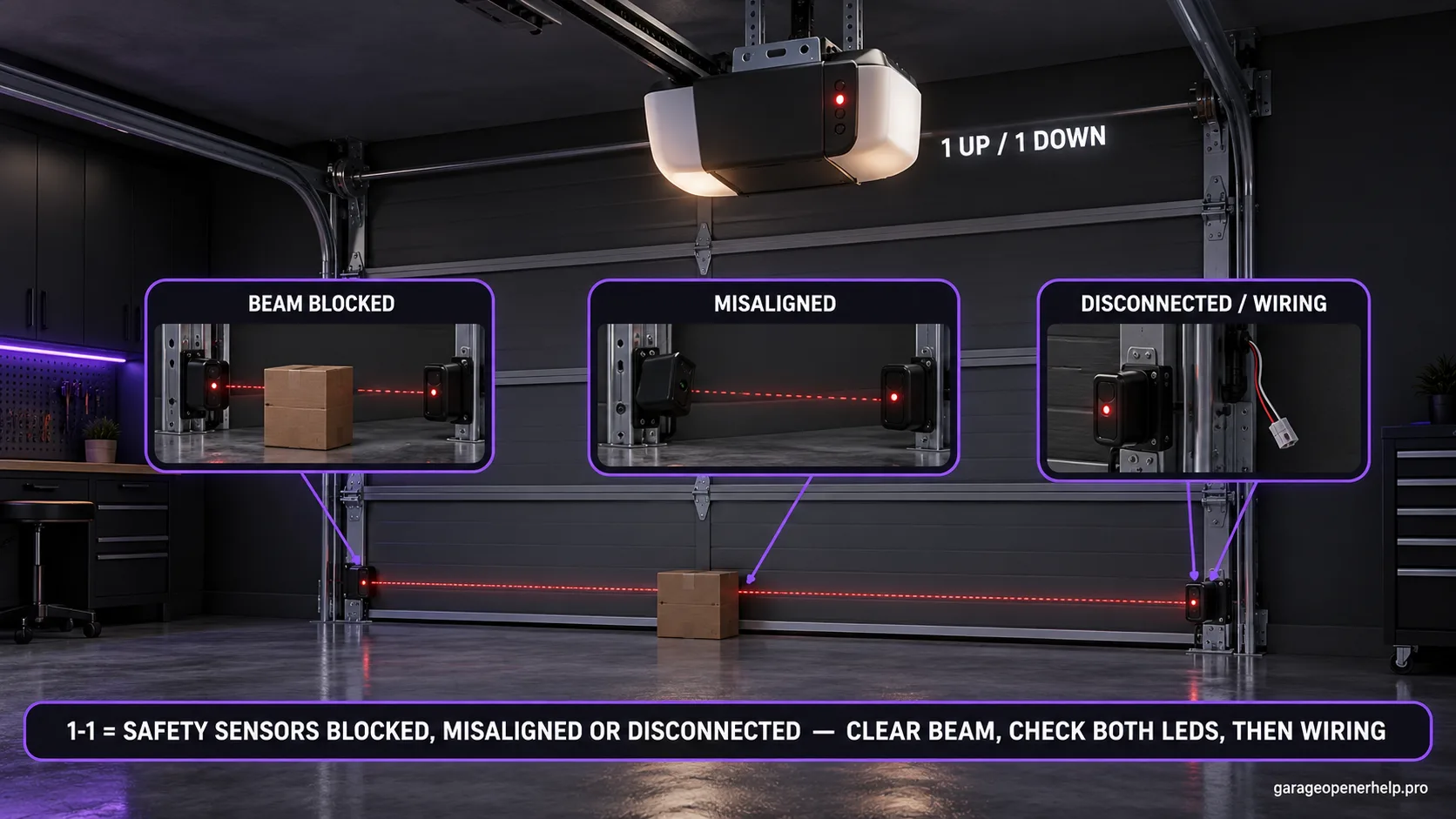
Read an UP / DOWN diagnostic code in the correct order
Which arrow flashes first, and how many times?
Security+ 2.0 openers with UP and DOWN adjustment arrows report a code as UP-arrow flashes followed by DOWN-arrow flashes, then pause and repeat. A 4-1 therefore means four UP flashes followed by one DOWN flash; the code does not mean '41 flashes'.
This exact manufacturer signal can feed the following diagnostic families. Keep the original code or LED pattern when troubleshooting.
What you are likely to notice
- The door begins to close and reverses open, or stays open and will not move down
- A compatible LiftMaster/Chamberlain unit reports 1-1
- One or both safety-sensor LEDs may be dark or unstable
Check these in order
1. Clear the sensor path
Remove storage, cobwebs and debris from the beam near the floor. A physically blocked beam is the simplest documented 1-1 branch.
2. Read both sensor LEDs
A steady amber sending LED and steady green receiving LED indicate alignment. Dark or flickering LEDs point toward wiring, power, obstruction or alignment depending on the exact pair.
3. Check alignment and connections
Aim the sensors directly at each other and confirm the low-voltage wires are secured at the opener and sensor connections. Do not move track hardware to force alignment.
4. Escalate damaged wiring or failed sensors
If alignment and accessible connections are correct but 1-1 remains, Chamberlain Group notes damaged wires or a sensor problem as possible causes. Move to exact wiring/LED diagnosis rather than swapping random parts.
1-1 is broader than a simple alignment warning
Chamberlain Group's 1-1 definition covers obstruction, misalignment, disconnection and wiring trouble. That is why a page that says only 'align the sensors' is incomplete. The LED pair tells you which sub-branch deserves attention first.
If both LEDs are steady and the beam is clear, repeated 1-1 behavior deserves exact model/wiring diagnosis. Do not keep moving correctly aligned sensors just because the code belongs to the safety circuit.
How 1-1 differs from 1-2
Code 1-2 is specifically a shorted or reversed sensor-wiring condition in Chamberlain Group diagnostics. Code 1-1 is broader and includes sensors that are blocked, misaligned, disconnected or affected by wiring. Keeping the two pages separate helps users start from the code they actually see.
The practical difference is the next check: 1-1 starts with the beam, alignment and sensor connectivity, while 1-2 sends you more directly toward shorted or reversed sensor wiring.
Use the amber/green pair to narrow Error 1-1
Chamberlain Group defines 1-1 as a safety-sensor condition involving obstruction, misalignment, disconnection or a wire break. On Security+ 2.0 openers that use UP/DOWN adjustment arrows, the code is 1 UP and 1 DOWN. The visible door behavior can be a close attempt that reverses or a door that stays open, so the code and sensor LEDs are more discriminating than the door symptom alone.
The manufacturer's detailed code table branches again by LED state. Both LEDs off keeps installation/sending-wire faults high on the list. Amber solid with green off can indicate obstruction, misalignment or a receiving-eye wire problem. Amber solid with green flickering supports obstruction or slight misalignment. Record the LED pair before disturbing the brackets because it can turn one broad 1-1 code into a much narrower service note.
- Confirm the code is 1 UP / 1 DOWN on the correct opener generation.
- Record amber and green LED states before realignment.
- Treat damaged wiring or a persistently dead sensor as a different branch from a momentary beam obstruction.
Record three pieces together: the 1-UP/1-DOWN code, the amber/green sensor state and the exact close behavior. If the opener also flashes or clicks ten times, note that without treating it as a separate diagnosis. Keeping the code and LED pair together helps distinguish a persistent wiring/sensor fault from a temporary obstruction that was already cleared.
Stop DIY troubleshooting when…
- The sensor circuit has damaged wiring inside a wall or opener housing
- The door is off-track, heavy or mechanically unsafe
- The sensor bracket cannot hold alignment
- The code returns with both LEDs steady and the beam clear
Garage door springs, cables and a falling/unbalanced door can store or release dangerous force. Those are door-system problems, not just opener settings.
Common questions
What does LiftMaster error 1-1 mean?
Chamberlain Group says the safety sensors may be blocked, misaligned, disconnected or affected by wiring.
Is 1-1 the same as 1-2?
No. 1-2 is specifically shorted or reversed safety-sensor wiring, while 1-1 is a broader sensor obstruction/alignment/connection fault.
Can I bypass the sensors to clear 1-1?
No. The safety-reversing sensors are a required protective system; correct the fault instead of defeating the sensors.
Manufacturer sources used
These links are the factual baseline for the diagnostic claims above. Model-specific manuals can supersede general guidance.