Chamberlain Group — whose sensor design is shared by Chamberlain, LiftMaster and Craftsman openers — says both safety-sensor LEDs can be off when the sensors are not connected or installed, the low-voltage wire is shorted or broken, or a sensor is faulty. Confirm the opener has power, then verify the wiring path and the terminal connections (white wire to the white terminal, white/black wire to the dark terminal) before replacing the sensor pair. If neither LED lights when the sensors are brought straight to the opener on their wires, the fault is a sensor rather than the field wiring.
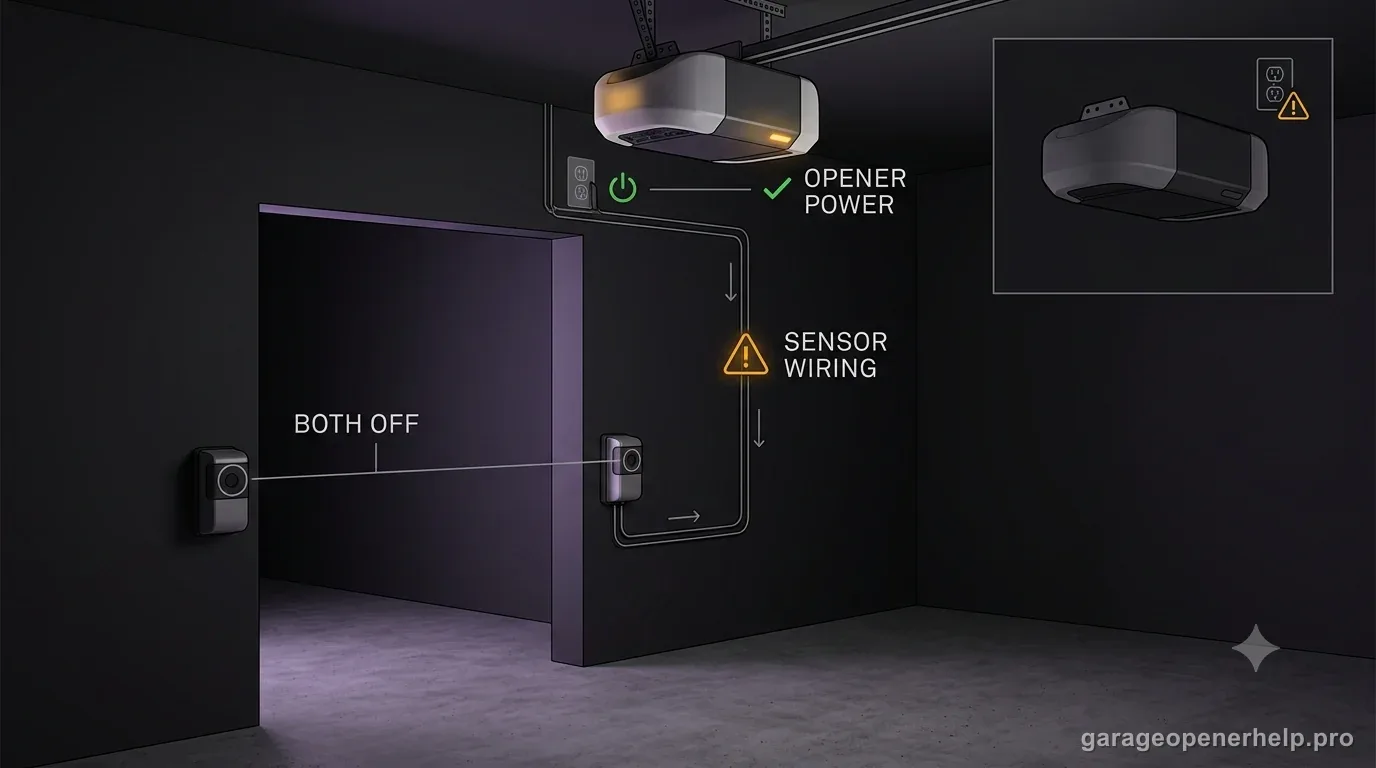
Read the two safety-sensor LEDs as a pair
Is the sender powered, and is the receiver seeing the beam?
Steady + steady = aligned baseline
On current Chamberlain Group safety-sensor guidance, amber identifies the sending sensor and green identifies the receiving sensor. Both LEDs steady is the normal aligned baseline; an off or blinking green receiver moves diagnosis toward alignment, obstruction or receiving-side wiring depending on the exact state.
This exact manufacturer signal can feed the following diagnostic family. Keep the original code or LED pattern when troubleshooting.
What you are likely to notice
- The amber (Chamberlain-family) sending LED is off
- The green receiving LED is also off
- The opener is a LiftMaster or Craftsman unit — the Chamberlain Group sensor pair behaves the same
- The door will not close normally and affected older openers may flash or click ten times
Check these in order
1. Confirm the sensors are installed and connected
Chamberlain lists missing or disconnected sensors as one both-off cause. Verify each sensor has its low-voltage wiring and that the wiring reaches the opener terminals.
2. Inspect the terminal connections
On the documented wiring path, white conductors go to the specified white terminal and striped conductors to the corresponding dark/grey terminal. Pre-wired garages may use different cable colors, so preserve the sensor polarity relationship rather than relying only on jacket color.
3. Look for shorts and breaks
Staples, pinches and damaged insulation can interrupt the sensor circuit. Gently check that conductors are secured and inspect visible cable along framing.
4. Use a controlled sensor-vs-wiring test only if the manual supports it
Chamberlain publishes a method to bring the sensors to the opener to distinguish field wiring from sensor failure. If that process is outside your comfort level, stop and use support or a technician rather than cutting wires by guesswork.
Why both-off usually means 'electrical path' before 'alignment'
Alignment changes whether the two eyes see each other, but completely dark indicators point you first toward whether the sensor circuit is connected and powered. Chamberlain lists missing sensors, broken/shorted wire and sensor failure for the both-off state.
That order matters because moving two unpowered sensors will not restore their LEDs. Confirm the circuit exists before spending time on bracket aim.
Use the manufacturer's isolation test carefully
Chamberlain publishes a sensor-at-opener test to distinguish field wiring from a failed sensor pair. It is a useful diagnostic because sensors that light when connected at the opener with a short, known-good test wire point back toward a problem in the longer field wiring run.
The procedure involves manipulating low-voltage sensor conductors. If the installation is unclear, pre-wired, or you cannot confidently preserve the correct connections, use support rather than improvising.
Both LEDs off removes alignment from the first position
Chamberlain lists three broad causes when both safety reversing sensor LEDs are dark: the sensors are not connected/installed, there is a short or broken wire, or a sensor is faulty. The manufacturer's procedure starts with installation and wiring connections, not with aiming the sensor brackets. That ordering prevents a common dead end where a homeowner keeps adjusting sensors that are not powered correctly.
Confirm the opener has power, then inspect the visible low-voltage connections and wire path for damage. Chamberlain's short-wire diagnostic can separate field wiring from the sensors on compatible systems, but only use the exact procedure for your sensor generation. If both LEDs stay dark after a verified wiring/sensor check, the official guidance escalates beyond simple alignment and may ultimately include the logic board.
- Both dark: verify installation/wiring before alignment.
- If a short-wire test makes both LEDs light, the field wiring becomes the primary suspect.
- If the condition survives verified sensor/wiring checks, stop replacing unrelated parts and escalate model-specifically.
For a both-dark Chamberlain pair, record opener power status, whether the sensors are installed, whether visible low-voltage connections are seated and whether any wire damage is obvious. If an exact manufacturer short-wire test is performed safely, record its result. That single result can separate field wiring from the sensor pair and prevent unnecessary replacement of unrelated opener parts.
Stop DIY troubleshooting when…
- The wiring fault is inaccessible
- The opener terminal block is burned or damaged
- You are not comfortable isolating low-voltage sensor wiring
- The door has a spring, cable, track or balance problem
Garage door springs, cables and a falling/unbalanced door can store or release dangerous force. Those are door-system problems, not just opener settings.
Common questions
Why are both Chamberlain garage door sensor lights off?
Chamberlain lists unconnected/uninstalled sensors, a short or broken wire, or a faulty sensor as common causes.
Does both LEDs off mean both sensors failed?
Not necessarily. A wiring fault can make both sensors dark, so verify connections and the wire path before replacing them.
Why do some older openers flash ten times too?
On affected generations, safety-sensor faults can also produce a ten-flash/click indication. Chamberlain notes newer products after February 2022 changed that behavior.
Manufacturer sources used
These links are the factual baseline for the diagnostic claims above. Model-specific manuals can supersede general guidance.