Code 1-2 indicates the opener detected shorted or reversed safety-sensor wiring. Inspect the low-voltage sensor wiring and connections before replacing parts.
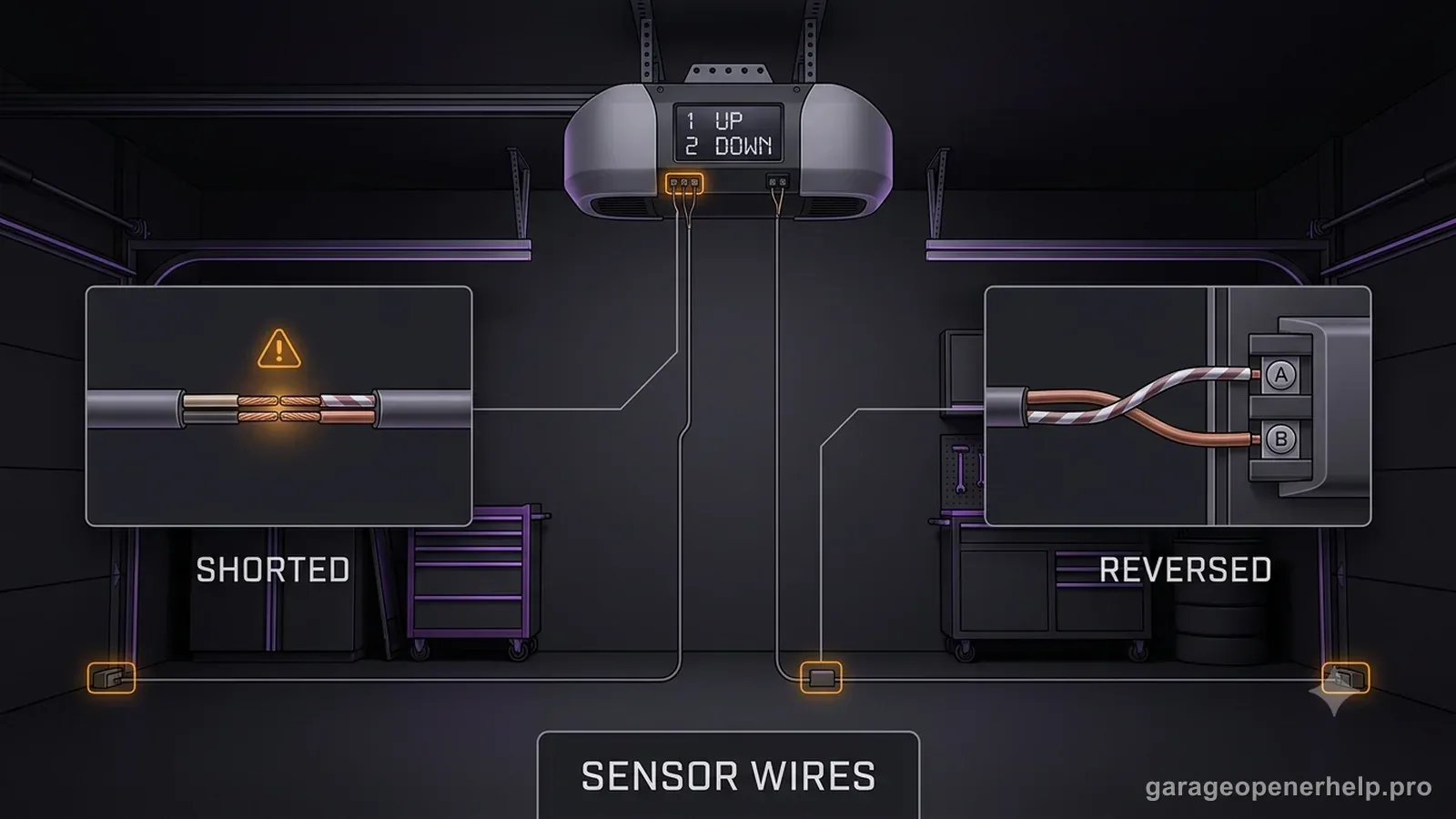
Read an UP / DOWN diagnostic code in the correct order
Which arrow flashes first, and how many times?
Security+ 2.0 openers with UP and DOWN adjustment arrows report a code as UP-arrow flashes followed by DOWN-arrow flashes, then pause and repeat. A 4-1 therefore means four UP flashes followed by one DOWN flash; the code does not mean '41 flashes'.
This exact manufacturer signal can feed the following diagnostic family. Keep the original code or LED pattern when troubleshooting.
What you are likely to notice
- Door will not close normally
- Opener lights may flash or click ten times on affected models
- One or both safety-sensor LEDs may be off or unstable
Check these in order
1. Inspect the sensor path
Confirm nothing blocks the photo-eye path and that both sensors face each other. This does not fix a wiring fault, but it separates alignment symptoms from an electrical connection problem.
2. Inspect the low-voltage wire
Look for staples driven through the wire, cuts, crushed insulation, loose terminal connections or exposed copper touching another conductor.
3. Check polarity / terminal placement
Follow the wiring diagram for your exact opener and sensor generation. If wires were recently moved, confirm the conductors are landed on the specified terminals.
4. Re-test once
After correcting an obvious low-voltage wiring problem, cycle the door once. If the diagnostic returns, move to model-specific support rather than repeatedly rewiring by trial and error.
How to tell wiring trouble from simple sensor misalignment
A misaligned photo eye and a wiring fault can both end with a door that refuses to close, but the repair path is different. Code 1-2 specifically directs attention to the safety-sensor wiring circuit. That is why the first visual inspection should follow the low-voltage cable from each sensor toward the opener rather than immediately replacing the photo eyes.
Look closely where cable is stapled to framing, turns around a corner, enters the opener or was recently disturbed by storage, painting or construction. A staple that compresses both conductors can create a short without leaving an obvious cut. Exposed copper at the terminal can also touch the neighboring conductor.
What to record before changing anything
Take a photo of the existing terminal connections and note which sensor LEDs are lit. That gives you a reference if someone has already changed wiring. If the problem appeared immediately after a sensor replacement, opener replacement or garage renovation, the timing is useful evidence that a connection was moved or damaged.
After correcting one obvious issue, test once. Avoid making several wiring changes at the same time because you lose the ability to identify which change mattered. If the code persists with intact visible wiring and correctly landed conductors, the next step should be model-specific electrical diagnosis rather than guessing at replacement parts.
1-2 is a sensor-wire polarity/short branch
Chamberlain Group's Security+ 2.0 diagnostic table describes 1-UP/2-DOWN as reversed safety-sensor wires or a short between the white and black terminals that persists for more than four seconds. The door may reverse from a close attempt or remain open, so the visible movement alone cannot separate 1-2 from nearby sensor codes.
For 1-2, wiring evidence should outrank alignment guesses. Chamberlain specifically points to reversed connections in pre-wired and non-pre-wired installations, damaged/shorted wire and staples or fasteners that can compromise the low-voltage cable. Preserve the code and both sensor LED states, then inspect only accessible low-voltage connections. If the wiring path is hidden or the fault is not obvious, stop before invasive electrical work and escalate with the code intact.
- 1-UP/2-DOWN: prioritize reversed/shorted sensor wiring.
- Do not treat 1-2 as a simple bracket-alignment code.
- Document pre-wired vs direct wiring and any recent sensor/garage wiring work.
Record whether the garage is pre-wired, the 1-UP/2-DOWN code, both sensor LED states and any visible reversed, pinched or stapled low-voltage wire. If the fault appeared after sensor replacement or remodeling, include that timing. Those facts are more diagnostic for 1-2 than repeated attempts to re-aim already connected sensors.
Stop DIY troubleshooting when…
- Wiring disappears into a damaged wall cavity
- The opener terminal block is burned or damaged
- You are unsure which conductors belong to the safety circuit
Garage door springs, cables and a falling/unbalanced door can store or release dangerous force. Those are door-system problems, not just opener settings.
Common questions
Can dirty lenses cause code 1-2?
Dirty or misaligned lenses can cause closing problems, but 1-2 specifically indicates a safety-sensor wiring issue in Chamberlain Group diagnostics.
Why do the opener lights flash or click ten times?
On affected models, that behavior accompanies certain safety-sensor faults. Chamberlain Group notes that newer units manufactured after February 2022 may not use the same ten-flash indication.
Can I bypass the safety sensors permanently?
The safety-reversing system is a required protective feature. Repair the fault rather than defeating or permanently bypassing the sensors.
Manufacturer sources used
These links are the factual baseline for the diagnostic claims above. Model-specific manuals can supersede general guidance.