On Security+ 2.0 openers that still report this diagnostic, LiftMaster/Chamberlain error code 1-4 means the safety sensors were obstructed or misaligned for less than four seconds. A person or object briefly crossing the beam can be normal, but a slightly flickering green receiving LED points to marginal alignment. Chamberlain Group notes that openers or replacement logic boards manufactured after February 3, 2022 no longer use this 1-4 feature, so confirm the opener generation before relying on the code.
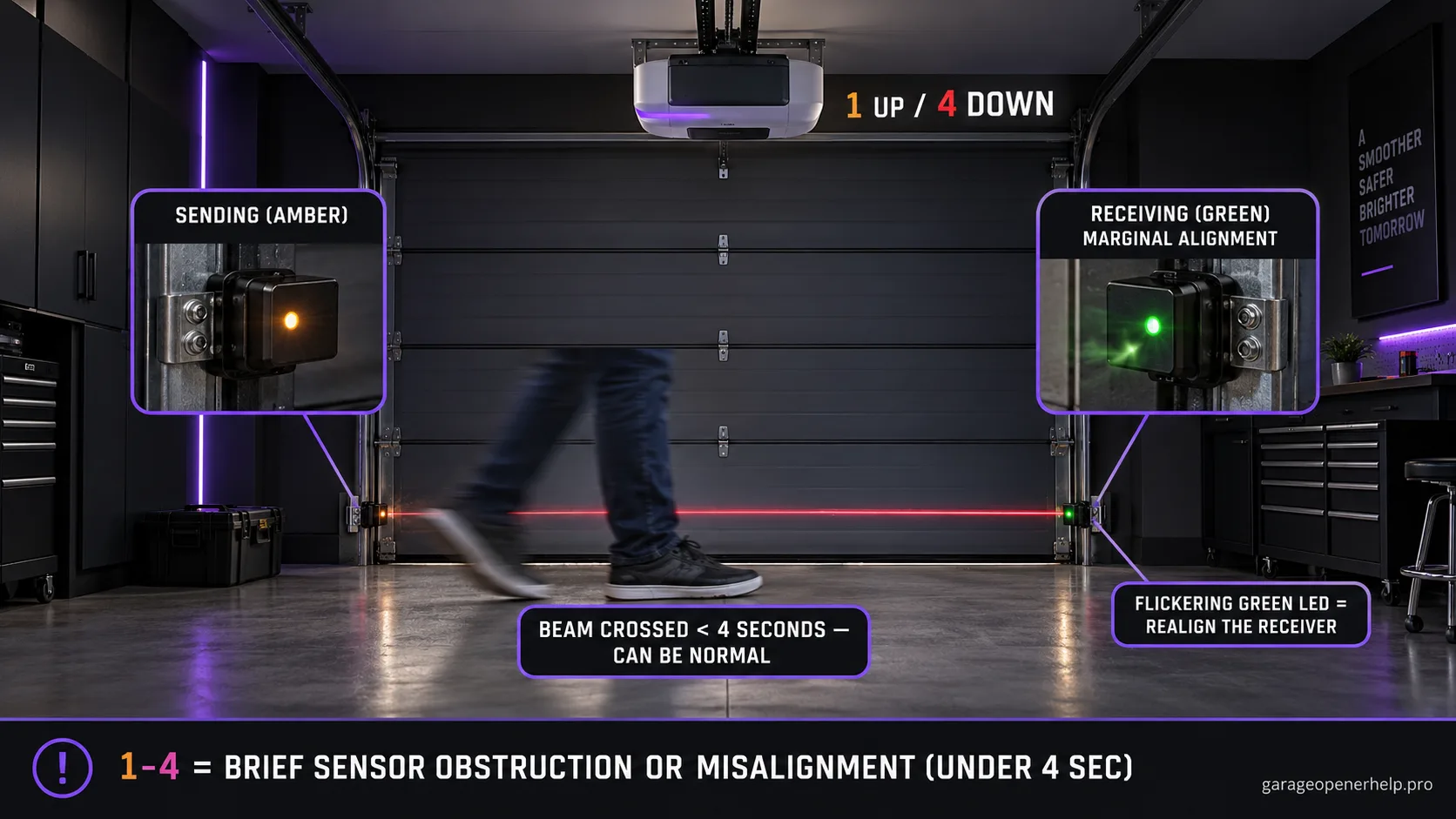
Diagnostic snapshot
- Answer
- Code 1-4 means the safety sensors were obstructed or misaligned for less than four seconds.
- Check first
- Clear the beam and watch whether the receiving green LED is solid or slightly flickering.
- Strong clue
- A momentary beam crossing can be normal; a slightly flickering receiver points toward marginal alignment.
- Model / generation note
- Applies to supported Security+ 2.0 diagnostic-code systems; newer sensor hardware may present indicators differently.
Read an UP / DOWN diagnostic code in the correct order
Which arrow flashes first, and how many times?
Security+ 2.0 openers with UP and DOWN adjustment arrows report a code as UP-arrow flashes followed by DOWN-arrow flashes, then pause and repeat. A 4-1 therefore means four UP flashes followed by one DOWN flash; the code does not mean '41 flashes'.
This exact manufacturer signal can feed the following diagnostic family. Keep the original code or LED pattern when troubleshooting.
What you are likely to notice
- The opener reports 1 UP / 4 DOWN
- The door briefly refused or reversed while closing
- The green receiving LED flickers slightly or only during vibration
- The problem may disappear after the beam is clear
Check these in order
1. Decide whether the interruption was momentary and explained
Chamberlain Group explicitly notes that a person or object passing through the photo-eye beam can create this short-duration condition and requires no repair once the path is clear. If the code appeared exactly when someone crossed the opening, do not turn a normal safety response into a parts diagnosis.
2. Read the receiving LED while the garage is still
With the beam clear, the receiving green LED should be solid on the applicable sensor family. A slight flicker is evidence that alignment is marginal even if the door sometimes closes normally. Re-align the sensors using the manufacturer procedure and tighten the bracket without changing the required mounting height.
3. Look for intermittent causes rather than a permanent short
A loose bracket, vibration, stored items moving into the beam, direct sunlight, or a wire connection that changes with movement can create an intermittent symptom. The distinction matters because 1-2 is the stronger wiring-short/reversed-wire branch, while 1-4 is the short obstruction/alignment event.
4. Test the safety reversal after the LEDs are stable
Once both indicators are normal, run the manufacturer's safety test. If the green LED stays solid but 1-4 returns without a visible obstruction, record the exact time, lighting conditions and whether vibration coincides with the event before escalating to model-specific sensor diagnosis.
Why 1-4 is different from a persistent sensor fault
The time window is the useful part of the code. Chamberlain Group defines 1-4 as an obstruction or misalignment lasting less than four seconds. That means a person walking through the beam, a box swinging into the path or a slightly unstable receiving eye can fit the event without implying a permanently failed sensor.
If the green receiving LED flickers only when the track vibrates, when sunlight reaches the opening or when a loose bracket moves, the intermittent evidence matters more than replacing both sensors. Stabilize the documented normal LED state first, then retest.
What not to infer from one short event
A single 1-4 event does not prove the sensor wiring is shorted and it does not prove the logic board is bad. Those are separate branches with their own codes and LED patterns. The safest process is to reproduce the condition only through normal door operation while observing the beam path and LEDs.
If the event cannot be explained and keeps returning with solid LEDs, record the exact opener model, time of day and whether the failure happens at the same door position. That evidence can expose bracket vibration, sunlight or an intermittent connection without turning a short-duration safety response into random parts replacement.
When intermittent really means intermittent
If 1-4 happens only at one time of day, compare the receiver LED under the same lighting condition. Chamberlain Group separately documents sunlight as a possible interference source for safety sensors, so a repeatable morning or afternoon pattern is useful evidence even when the beam is physically clear.
If the event follows door vibration rather than sunlight, watch the sensor bracket and low-voltage lead while the door operates from a safe distance. A bracket that shifts a few millimeters can turn a nearly aligned system into a brief 1-4 event without leaving a permanent fault afterward.
Stop DIY troubleshooting when…
- A sensor bracket or wire is physically damaged
- The green receiving LED cannot be made steady
- The door has unrelated mechanical damage or is off track
- The code repeats with stable LEDs and a clear beam
Garage door springs, cables and a falling/unbalanced door can store or release dangerous force. Those are door-system problems, not just opener settings.
Common questions
Does 1-4 mean the safety sensors are bad?
No. Chamberlain Group says 1-4 can be caused by a brief obstruction or slight misalignment. A defective sensor is not the only explanation.
Why does the door work again after code 1-4?
If the obstruction was temporary, the opener can return to normal once the beam is clear. A marginally aligned receiver can also work intermittently.
Is 1-4 the same as 4-6?
No. Both involve the safety-sensor branch, but 1-4 specifically records a short-duration obstruction/misalignment event, while 4-6 is the close-command condition associated with an active 1-1/1-2 sensor fault on applicable systems.
Manufacturer sources used
These links are the factual baseline for the diagnostic claims above. Model-specific manuals can supersede general guidance.