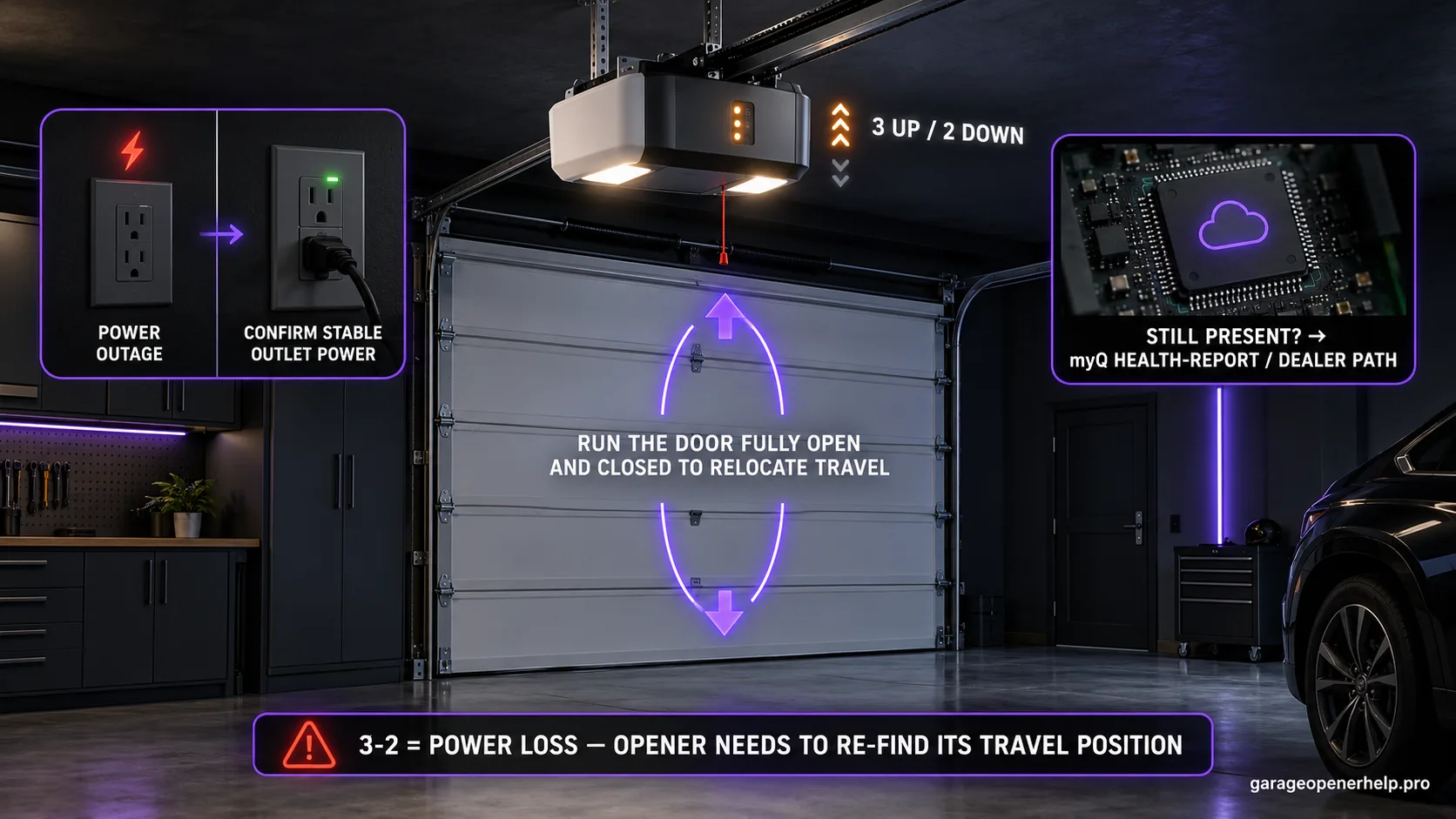
LiftMaster/Chamberlain error code 3-2 means the opener experienced a power outage and needs to locate its travel position. Confirm stable outlet power first. Chamberlain Group's detailed diagnostic table says to run the opener open and closed to clear the condition; current myQ support also exposes a dealer/health-report path when the error remains present.
Diagnostic snapshot
- Answer
- Code 3-2 means the opener lost power and needs to locate its travel position.
- Check first
- Confirm stable outlet power, then run a supervised normal open/close cycle as Chamberlain Group directs.
- Strong clue
- The code appearing immediately after an outage or unplugging is consistent with a recovery state, not automatic loss of remote/Wi-Fi programming.
- Model / generation note
- Persistent 3-2 errors can be reviewed through myQ Diagnostics/health reporting on supported connected models.
Read an UP / DOWN diagnostic code in the correct order
Which arrow flashes first, and how many times?
Security+ 2.0 openers with UP and DOWN adjustment arrows report a code as UP-arrow flashes followed by DOWN-arrow flashes, then pause and repeat. A 4-1 therefore means four UP flashes followed by one DOWN flash; the code does not mean '41 flashes'.
This exact manufacturer signal can feed the following diagnostic family. Keep the original code or LED pattern when troubleshooting.
What you are likely to notice
- The opener reports 3 UP / 2 DOWN after an outage or unplugging
- The opener recently lost AC power
- The door position may need to be re-established after power returns
- The error remains visible in myQ diagnostics
Check these in order
1. Confirm the outlet is actually stable
Before cycling the door, verify that the opener has normal AC power and that the problem is not a tripped breaker, switched outlet or intermittent receptacle. If power is still unstable, repeated travel attempts cannot complete a reliable recovery.
2. Let the opener re-establish travel position
Chamberlain Group's diagnostic table says to run the opener open and closed after power is restored to clear 3-2. Keep the opening clear and watch the full cycle. If the door cannot complete normal travel, stop and diagnose that separate mechanical/travel symptom rather than repeatedly forcing recovery.
3. Distinguish 3-2 from a lost-programming assumption
A power-loss travel-location code does not automatically mean remotes, Wi-Fi or learned travel settings were erased. Test the actual opener behavior first. Reprogramming every accessory can create additional problems without addressing the reported condition.
4. Use myQ diagnostics if the code remains
Chamberlain Group's current 3-2 support page directs users with persistent errors toward myQ Diagnostics and dealer health reports. If normal power is restored and a clean open/close cycle does not clear the code, preserve the report instead of guessing at the board or travel module.
3-2 is a recovery state after power loss
The detailed Chamberlain Group table describes 3-2 as the opener needing to locate its travel position after a power outage. That makes stable restored power a prerequisite. If the outlet is still dropping power, no amount of travel cycling can establish a reliable position.
Once power is stable, a normal full open/close cycle gives the opener the opportunity to clear the state. Watch the door rather than walking away; a new reversal, binding point or second diagnostic code is a different problem that should stop the recovery attempt.
Do not erase useful settings without evidence
A common reaction after an outage is to factory-reset Wi-Fi, erase remotes or relearn travel immediately. Code 3-2 by itself does not say those memories are gone. Begin with the documented recovery cycle and only reprogram a subsystem that actually proves it has lost configuration.
If the code stays present in myQ after normal power and travel return, the current support path allows a health report to be shared with a dealer. That preserves more diagnostic information than repeated resets.
What to watch during the recovery cycle
During the supervised open/close cycle, note whether the opener reaches both endpoints smoothly and whether any arrow code changes. If it stops short, reverses, strains, or reports a 4-x code, stop treating the event as a simple 3-2 recovery. The new symptom becomes the stronger diagnostic evidence.
Battery-backup models can mask a house-power problem because the opener may still move on battery. Confirm normal AC has actually returned rather than assuming movement proves the outlet is healthy. This matters before declaring the travel-location recovery complete.
Power restoration and battery backup can look deceptively similar
On a battery-backup opener, the motor may still run while the garage circuit is dead. Check the opener's AC-power indication and the outlet rather than using movement alone as proof that utility power has returned.
A clean 3-2 recovery should end with stable AC power and normal full travel. If the opener continues operating only on battery or reports a different code, diagnose that new state before assuming the travel-position issue is solved.
Stop DIY troubleshooting when…
- Power at the outlet is intermittent or unsafe
- The door cannot complete a normal open/close cycle
- The opener develops a second diagnostic code during recovery
- 3-2 remains after stable power and a normal cycle
Garage door springs, cables and a falling/unbalanced door can store or release dangerous force. Those are door-system problems, not just opener settings.
Common questions
Will 3-2 clear after power comes back?
Chamberlain Group's detailed table says to restore power and run the opener open and closed to clear the error. Persistent cases need further diagnosis.
Does 3-2 mean my travel limits were erased?
Not necessarily. The code says the opener lost power and needs to locate its travel position; it does not by itself prove permanent loss of programmed limits.
Should I reset myQ when I see 3-2?
Not as the first step. Confirm stable power and normal opener travel first. Use myQ Diagnostics if the error remains.
Manufacturer sources used
These links are the factual baseline for the diagnostic claims above. Model-specific manuals can supersede general guidance.