LiftMaster/Chamberlain error code 4-4 means the opener detected loss of motor RPM while trying to open. Chamberlain Group lists a loose travel-module assembly or wiring, and on some RJO systems an engaged emergency release, as documented branches. Safety-sensor obstruction belongs to other diagnostic code families, so keep the opening-direction RPM symptom separate.
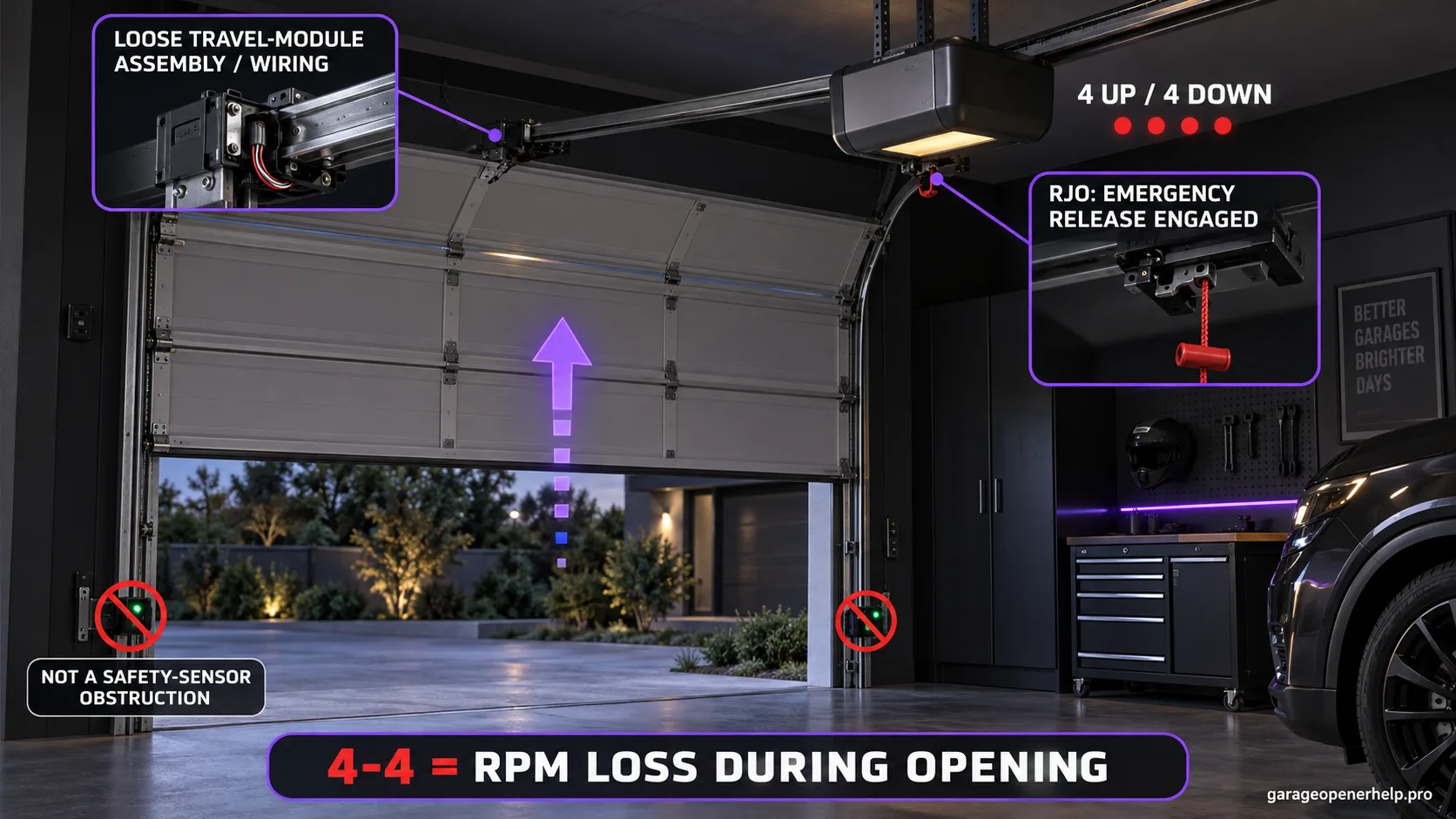
Choose the 4-4 branch by direction and hardware
Official sources define 4-4 as loss of RPM while opening; the published branches include travel-module wiring and an RJO release condition.
| Evidence | What it supports | Next step |
|---|---|---|
| 4 UP / 4 DOWN; door stops and reverses before fully open | Opening-direction RPM/power loss | Record model and stop point; compare to official 4-4 guidance. |
| RJO / wall mount; release was engaged during travel | A documented jackshaft emergency-release branch | Verify the release only using the exact model procedure. |
| Door is heavy or binds when closed | Door-system resistance may be present | Stop and request door service; do not alter spring tension or force settings. |
| Photo-eyes are dirty but code is 4-4 while opening | Sensor cleaning does not address this opening RPM code | Keep sensor faults separate unless an exact sensor code is also present. |
| Code returns after external checks | Travel module or connecting wires may need diagnosis | Share model, code and symptoms with a dealer; do not open the motor housing. |
A similar number does not mean the same fault: 4-3 is the documented down-travel RPM-loss code, 4-4 is up-travel loss, and 4-6 concerns closing sensors.
Diagnostic snapshot
- Answer
- LiftMaster/Chamberlain 4-4 is loss of RPM during UP travel. It is not the safety-sensor obstruction code.
- Check first
- Confirm the door actually stops while opening and count 4 UP / 4 DOWN flashes, then check whether the door moves freely by hand using the model's safe release procedure.
- Strong clue
- Chamberlain Group lists loose travel-module assembly/wiring and, on some RJO systems, an engaged emergency release for 4-4.
- Model / generation note
- Do not import safety-sensor fixes from other code families; 4-6 and the 1-x sensor codes cover those branches on Security+ 2.0 systems.
This exact manufacturer signal can feed the following diagnostic family. Keep the original code or LED pattern when troubleshooting.
What you are likely to notice
- The opener reports 4 UP flashes followed by 4 DOWN flashes.
- The garage door stops before reaching the full-open position.
- The door can return toward the closed position after the RPM loss.
- The problem occurs during opening, not because the photo-eye beam is blocking a close command.
Check these in order
1. Verify the direction before diagnosing the code
4-4 is an UP-travel RPM-loss code in Chamberlain Group's detailed table. If the failure happens only during closing, re-read the arrows because 4-3 is the corresponding DOWN-travel RPM-loss code.
2. Separate a binding/heavy door from internal RPM tracking
With the door fully closed and stable, follow the owner manual for a safe manual-movement check. A heavy or binding door needs door-system service before opener electronics are blamed.
3. On an RJO, verify the emergency release is reconnected
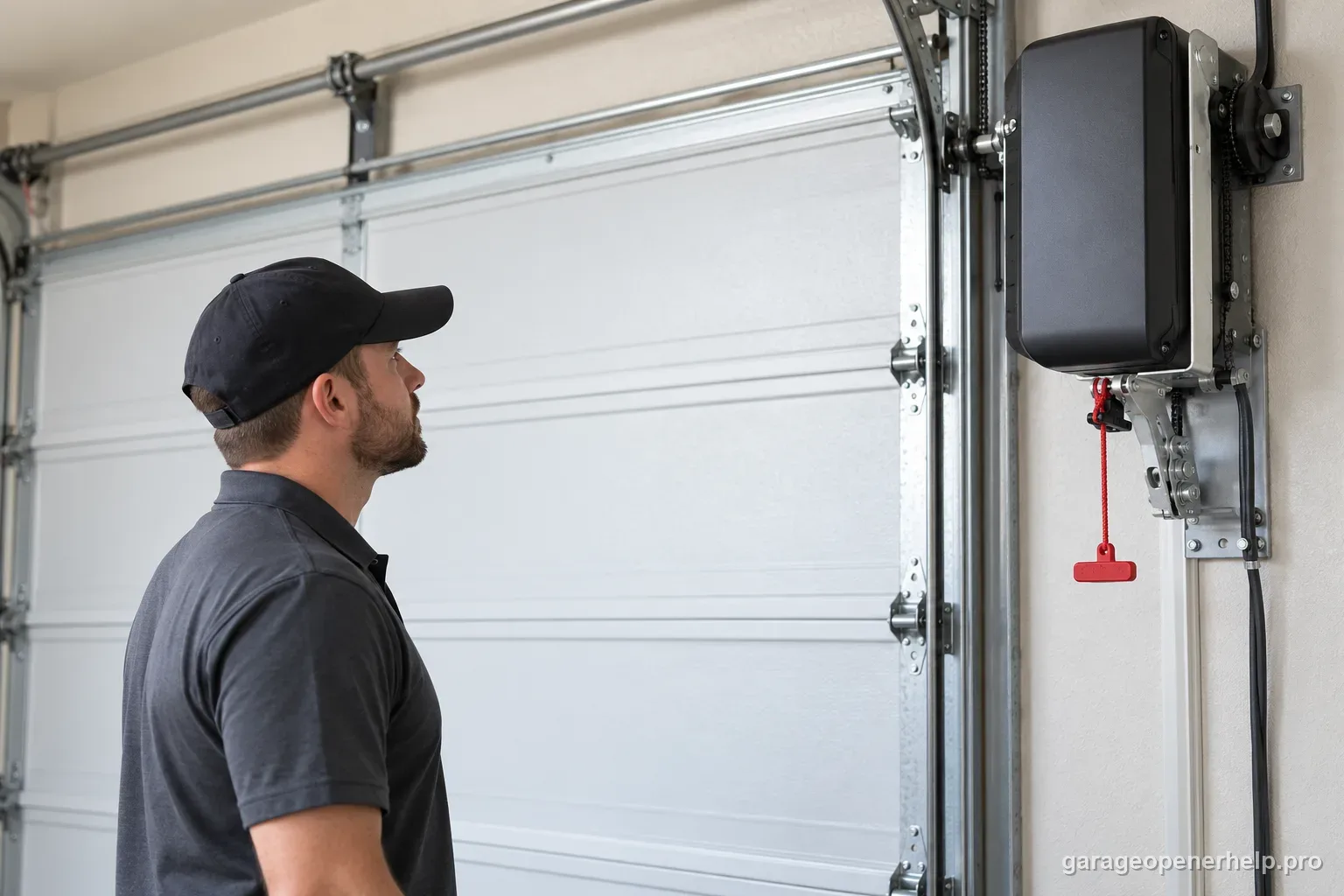
Chamberlain Group specifically lists an RJO emergency release engaged while traveling as a 4-4 branch. Reconnect it only according to the model manual; do not improvise around shaft collars, cables, or torsion hardware.
4. Treat travel-module assembly/wiring as internal service
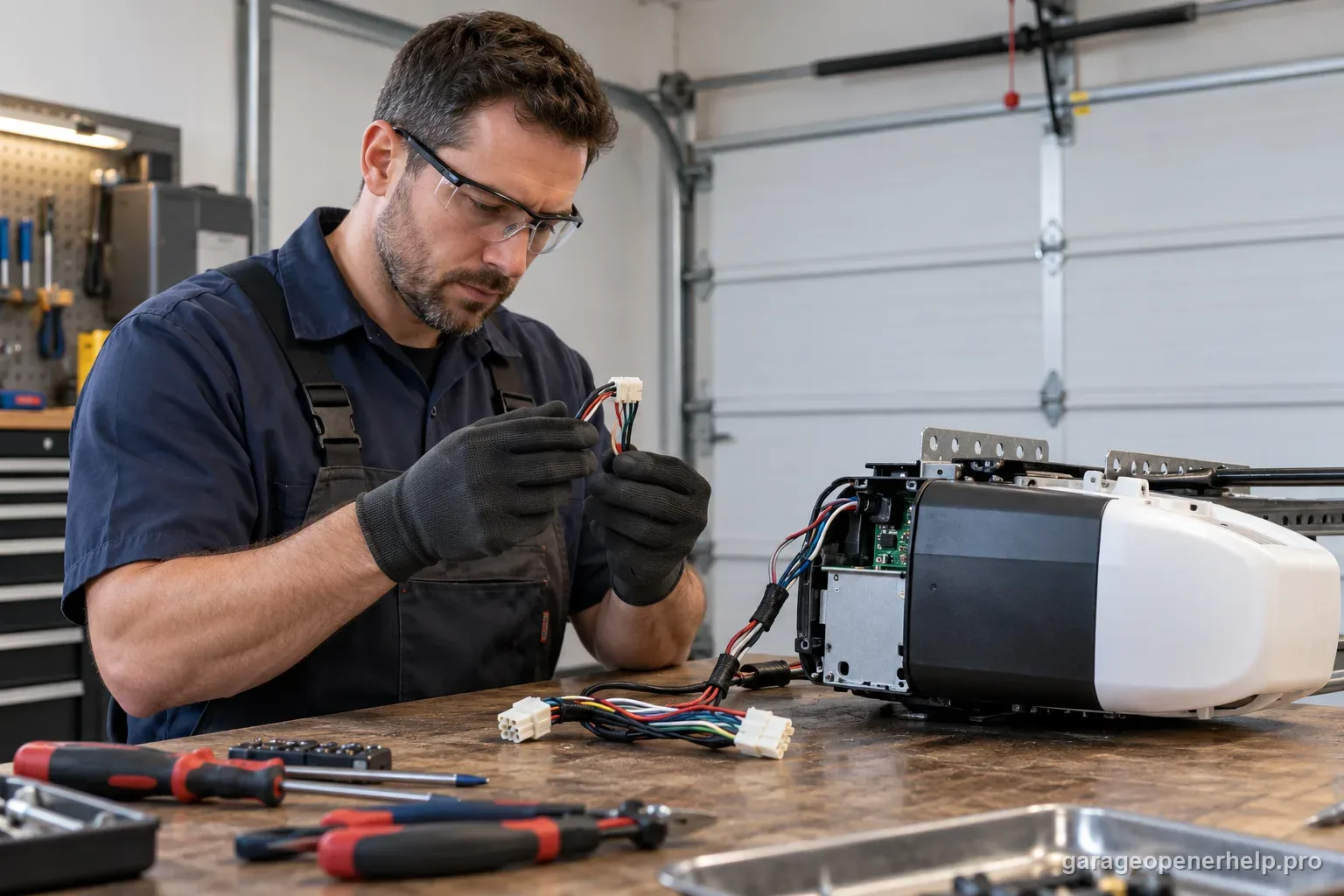
The detailed table lists loose travel-module assembly and wires. Those are not the same as safety sensors at the bottom of the door. If the door moves freely and the external release state is correct, use exact-model service documentation or a trained technician.
4-4 is not the safety-sensor obstruction code
Chamberlain Group's detailed Security+ 2.0 table defines 4 UP and 4 DOWN as loss of RPM during UP travel. The opener can stop before full open and, depending on behavior, return toward closed. That puts the code in the opening-direction RPM/travel branch rather than the safety-photo-eye branch.
Safety-sensor obstruction on this platform belongs to the 1-1/1-2/4-6 family and primarily affects closing. If the door is failing while opening and the arrows truly read 4-4, cleaning photo-eye lenses is not a code-specific fix.
Use direction to distinguish 4-4 from 4-3 and 4-2
Direction is the simplest high-value clue. Code 4-3 is loss of RPM during DOWN travel. Code 4-4 is loss of RPM during UP travel. Code 4-2 is a broader unexpected RPM/DC-current change during UP travel and includes mechanical resistance and limit/travel causes. These codes can feel similar to the homeowner because all may end with a door stopping short.
Count the UP flashes, then the DOWN flashes, and note whether the failure occurs while opening or closing. That two-part observation is more reliable than trying to name a failed component from memory.
External checks before travel-module service
First verify that the door itself is not unusually heavy or binding. On applicable RJO systems, Chamberlain Group also lists an engaged emergency release as a possible 4-4 condition. Reconnect only using the exact manual because wall-mount release hardware differs from trolley systems.
If the door is healthy and the release state is correct, the documented remaining branches include travel-module assembly or wire connections. Those are internal opener-service areas. The safest homeowner contribution is exact model identification, motion direction, code count, and whether manual door movement is normal.
What would make a 4-4 diagnosis less consistent
If the opener refuses to close and the safety-sensor LEDs are abnormal, re-read the code instead of forcing that symptom into 4-4. Likewise, if the arrows are 4 UP / 3 DOWN, the manufacturer defines that as RPM loss during DOWN travel, not UP travel. Direction and flash count should agree with each other.
Do not replace a pair of photo eyes, increase force, or clear every programmed accessory just to experiment with unrelated systems. The source-backed 4-4 path is opening-direction RPM feedback: verify the door, the RJO release state if applicable, then the exact model's travel-module/service branch.
Stop DIY troubleshooting when…
- The door is heavy, crooked, or difficult to lift manually
- An RJO release/shaft/cable condition is not clearly safe
- The problem points inside the travel-module/motor housing
- The code returns after the documented external checks
Garage door springs, cables and a falling/unbalanced door can store or release dangerous force. Those are door-system problems, not just opener settings.
Common questions
Does LiftMaster code 4-4 mean blocked safety sensors?
No. Chamberlain Group defines 4-4 as loss of RPM during UP travel. Safety-sensor faults use other codes such as 1-1, 1-2 and 4-6.
What is the difference between 4-3 and 4-4?
4-3 is loss of RPM during DOWN travel; 4-4 is loss of RPM during UP travel.
Can an RJO emergency release cause 4-4?
Chamberlain Group lists an RJO emergency release engaged while traveling as one possible 4-4 branch.
Manufacturer sources used
These links are the factual baseline for the diagnostic claims above. Model-specific manuals can supersede general guidance.