Code 4-5 means the operator encountered an unrecognized travel module. Chamberlain Group says to confirm the correct travel module is installed and replace it if needed; this is a parts/module identification problem rather than a reason to keep changing travel limits.
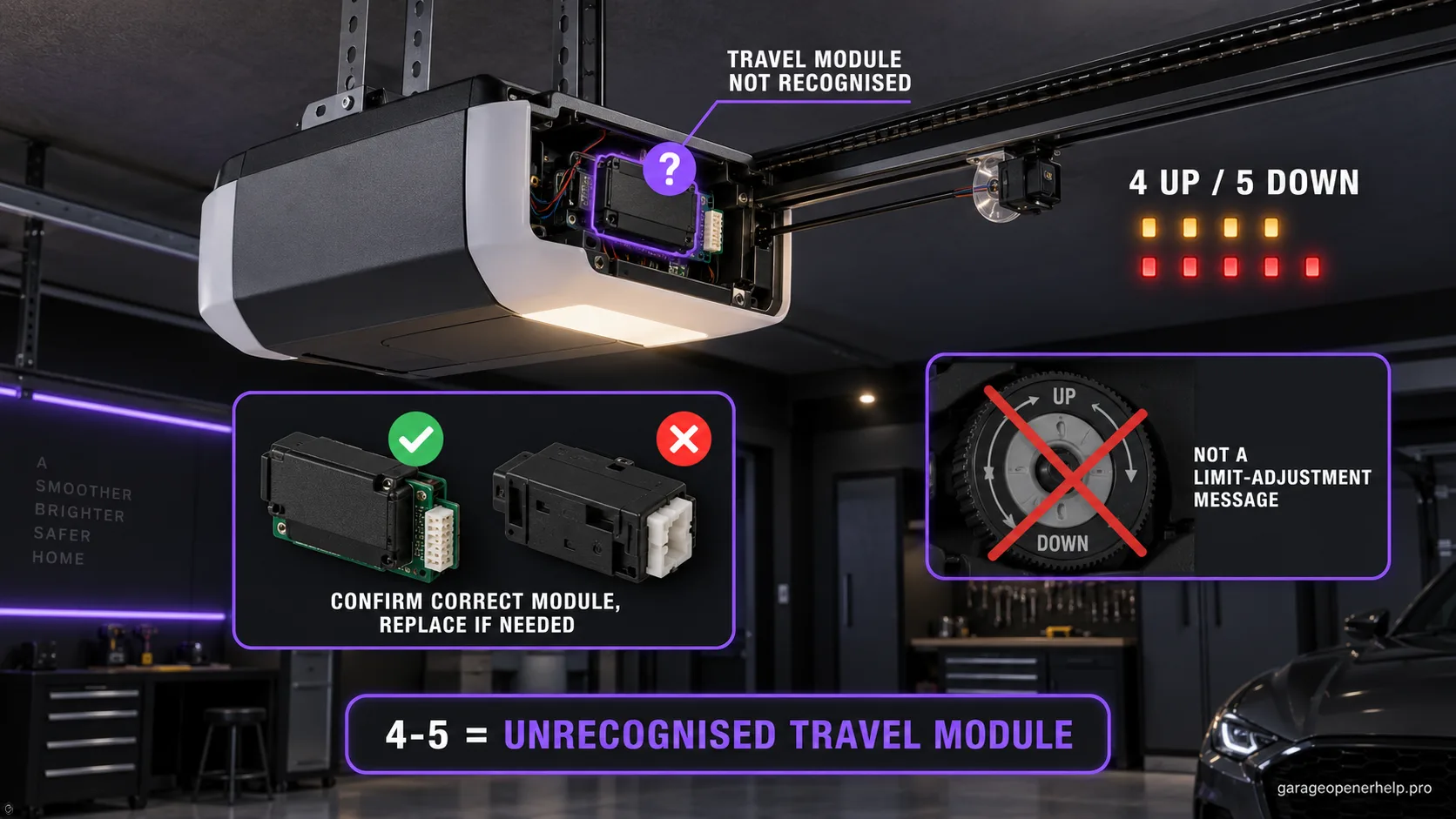
Read an UP / DOWN diagnostic code in the correct order
Which arrow flashes first, and how many times?
Security+ 2.0 openers with UP and DOWN adjustment arrows report a code as UP-arrow flashes followed by DOWN-arrow flashes, then pause and repeat. A 4-1 therefore means four UP flashes followed by one DOWN flash; the code does not mean '41 flashes'.
This exact manufacturer signal can feed the following diagnostic family. Keep the original code or LED pattern when troubleshooting.
What you are likely to notice
- The door may begin to close and then reverse to open
- The door may remain open and not move
- The diagnostic display reports 4-5
Check these in order
1. Stop reprogramming limits at random
An unrecognized travel module is different from a travel limit that simply needs adjustment. Repeating learn procedures does not make an incompatible or failed module become recognized.
2. Check whether opener service happened recently
If the code appeared after a logic-board, travel-module or opener repair, note exactly which part was installed. That timing is useful because the official fix centers on the correct travel module.
3. Record the opener model and replacement part number
Compatibility depends on the exact operator generation. Photograph the model label and any replacement-part label before contacting support or a dealer.
4. Use the correct replacement path
Chamberlain Group's published resolution is to ensure the correct travel module is installed and replace it if necessary. Treat that as a verified-parts task, not a generic force or sensor adjustment.
Why part identity matters more than adjustment
A travel module is not just a number you can relearn through button presses if the operator does not recognize the hardware. Chamberlain Group's published fix is to confirm that the proper travel module is installed and replace it when necessary. That is a compatibility and component-identification problem.
If 4-5 appeared after service, the strongest clue is often the sequence of parts that changed. Capture the opener model and the part number on the installed module before anything else is replaced.
Avoid turning one verified fault into three guesses
Online troubleshooting often jumps from reversal symptoms to sensors, force settings and logic boards at the same time. A confirmed 4-5 code gives you a narrower starting point. Keep the diagnosis anchored to the unrecognized travel module until the correct part relationship has been verified.
For a confirmed 4-5 code, the high-value question is whether the installed travel module is the correct part for the exact opener. Verify that operator-to-module relationship instead of working through unrelated sensor, force or generic repair steps.
Treat 4-5 as a component-identity problem
LiftMaster/Chamberlain defines 4-5 as an unrecognized travel module. The reported door can begin to close and reverse, or it may remain open without moving. Those behaviors overlap with other faults, but the verified 4-5 code is the higher-quality signal and should keep the diagnosis centered on the travel module rather than safety sensors or force settings.
The manufacturer's fix is to confirm that the correct travel module is installed and replace it if necessary. If the code appeared after service, record the opener model, the installed travel-module part identity and the order of recent repairs before additional parts are changed. This is a good stop-DIY boundary because correct component matching matters more than a generic reset sequence.
- Verify 4-UP/5-DOWN before using this branch.
- Prioritize correct travel-module identity over travel/force adjustment guesses.
- If the module was recently replaced or internal work is required, move to dealer/service verification.
Because 4-5 is about an unrecognized travel module, record the opener model, the exact 4-UP/5-DOWN code and any travel-module or logic-board service that happened immediately before the fault. If an installed module part number is visible without opening unsafe areas, include it. The strongest handoff is a component-identity trail, not a list of unrelated sensor or force adjustments.
Stop DIY troubleshooting when…
- The repair requires opening the powered opener housing
- You cannot verify the installed module part number
- The code began after board/module replacement
- The door also has a mechanical balance or track problem
Garage door springs, cables and a falling/unbalanced door can store or release dangerous force. Those are door-system problems, not just opener settings.
Common questions
What does LiftMaster 4-5 mean?
Chamberlain Group defines 4-5 as an unrecognized travel module.
Can I clear 4-5 by relearning the open and close limits?
The official resolution focuses on confirming the correct travel module and replacing it if necessary, so limit relearning is not a substitute for correct hardware.
Is 4-5 a safety-sensor code?
No. The published 4-5 diagnostic is about the travel module, even though the door may reverse or remain open.
Manufacturer sources used
These links are the factual baseline for the diagnostic claims above. Model-specific manuals can supersede general guidance.